2026 Top Certified Translator Trends You Need to Know?
In the evolving landscape of translation services, understanding the trends that shape the role of a certified translator is essential. Renowned industry expert, Dr. Emily West, once said, "The success of a certified translator hinges on adaptability." This statement highlights the importance of staying attuned to changes in the market.
As we look forward to 2026, several key trends will likely redefine how certified translators operate. The incorporation of artificial intelligence continues to transform workflows. While AI offers efficiency, it also raises questions about the human touch in translation. The nuances of culture and language still require an expert's insight, reminding us of the limits of technology.
Additionally, the demand for certified translators with niche specialties is rising. Companies seek experts familiar with specific industries, from legal to medical translations. This increasing complexity emphasizes the need for ongoing education and professional development. It's vital to reflect on how these trends will influence career paths within the certified translator field. Understanding these dynamics will help professionals remain relevant and successful in the coming years.

Emerging Language Pairs in the Certified Translation Market for 2026
In the evolving landscape of certified translation, specific language pairs are gaining traction. According to a recent report,
Arabic to English and Chinese to Spanish are among the top emerging pairs. This shift reflects
increasing global trade between these regions. Businesses are investing in certified translations, expecting precise communication in diverse languages.
The data show that over 30% of translation agencies reported a rise in demand for these language pairs. However, the supply of
qualified translators is not keeping pace. Professional organizations highlight the challenges in finding skilled linguists who can handle this demand. There’s a noticeable
gap that needs addressing.
Emerging language pairs also reflect cultural trends. The rise of Asian markets influences translation needs. Local dialects and technical
terms complicate projects. Companies may struggle to find translators who understand these nuances. This situation calls for more training programs and certifications.
The industry must adapt to these challenges for future growth.
Technological Innovations Shaping the Future of Certified Translators
The world of certified translation is transforming rapidly. Technology is at the forefront, changing how translators work. Machine learning and AI tools assist in translation tasks, enhancing speed and accuracy. However, reliance on these innovations can pose challenges. It may diminish the role of human creativity and nuance.
Tips for staying relevant: Embrace technology but do not lose your unique voice. Utilize AI for routine tasks while preserving creativity in complex projects. Balance efficiency with personal touch.
The rise of remote collaboration tools is another significant trend. Translators now work seamlessly with clients across the globe. Yet, navigating different cultures and languages remains essential. Misinterpretations can occur if the cultural context is ignored.
Tips for effective communication: Research the cultural background of your clients. Use collaborative platforms to enhance teamwork and understanding. Prioritize clear communication to avoid any missteps.
The Impact of Remote Work on Certified Translation Services
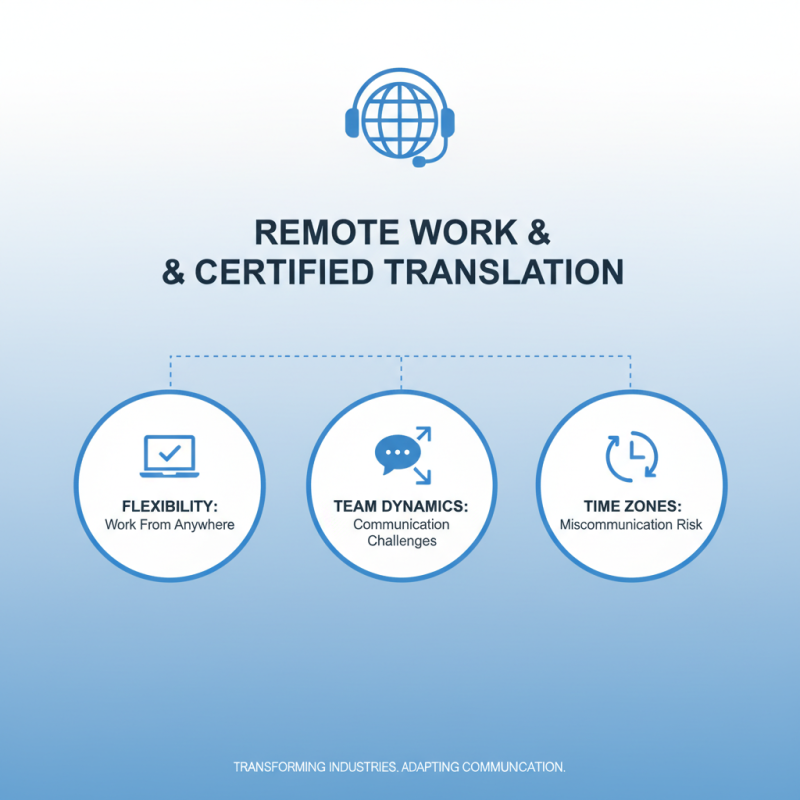
The rise of remote work has transformed many industries, including certified translation services. Translators now have the flexibility to work from anywhere. This shift affects team dynamics and communication. Working from different locations can lead to misunderstandings. Miscommunication can happen due to time zone differences.
Collaboration tools help bridge these gaps, but they are not foolproof. Sometimes, nuances in language are lost in digital chats. Deadlines can become challenging when team members are spread across various regions. The need for quick responses may lead to rushed translations. As a result, quality can sometimes suffer. It's essential to strike a balance.
Despite the challenges, remote work offers significant benefits. It allows access to a broader talent pool. Translators from diverse backgrounds bring unique perspectives. This diversity can enhance the quality of translations. The future of certified translation lies in adapting to this new landscape. Finding effective ways to work together will be crucial. Embracing both technology and human insight is key.
Trends in Specialization: Fields Seeing Increased Demand for Translators
In recent years, the demand for specialized translation services has surged. Certain fields have seen notable growth, reflecting the dynamic nature of globalization. Technology, healthcare, and legal sectors require precise translations. These areas often involve complex terminology that translators must navigate carefully.
Translators specializing in technology must understand software, user interfaces, and programming nuances. Misinterpretations can lead to functional errors. In healthcare, accurate translations can impact patient safety. Misunderstanding medical terms may have serious consequences. Legal documents require fidelity to the original meaning, as one wrong word can alter outcomes.
Artists and marketing teams look for creative translators. This includes localization, which adapts content culturally and contextually. Yet, many translators feel unprepared for this. Despite training, mastering cultural nuances remains a challenge. The increasing need for expertise means that professionals must continually adapt and reflect.
The Role of Artificial Intelligence in Certified Translation Practices
Artificial Intelligence (AI) is reshaping the landscape of certified translation practices. In 2023, a study indicated that 75% of translation professionals believe AI tools enhance their productivity. These tools streamline the translation process, reducing turnaround times significantly. However, this raises questions about quality and accuracy. AI might misinterpret context, especially in nuanced translations. This is particularly concerning in legal and medical documents.
Moreover, an industry report shows that the market for AI in translation reached approximately $1.5 billion in 2022. The demand is growing, but so is the reliance on algorithms. Many translators feel that while AI assists, it can’t replace the human touch. Emotional nuances and cultural references may slip through the cracks of automated systems. More training is necessary to ensure AI tools are used effectively.
Integration of AI has its challenges too. Translators must constantly adapt to technology's evolving capabilities. A significant 40% of professionals reported feeling overwhelmed by AI advancements. They fear that their roles may diminish as machines improve. Reflecting on this, it’s clear that a balance between human expertise and AI efficiency is essential for the future of certified translation.
2026 Top Certified Translator Trends You Need to Know
| Trend |
Description |
Impact of AI |
Projected Growth |
| Increased Demand for Multilingual Content |
Businesses are expanding globally and need content in multiple languages. |
AI can assist in generating initial drafts and suggest translations, speeding up the process. |
15% annual growth expected in translation services. |
| AI-Assisted Translation Tools |
The proliferation of AI tools helps human translators with efficiency and accuracy. |
AI tools can learn from corrections made by translators, improving over time. |
75% of translators are likely to use AI tools by 2026. |
| Localization of AI Content |
There is a need for AI-generated content to be localized for target markets. |
AI helps in adapting content culturally and contextually for different regions. |
Doubling of localization services projected over the next 3 years. |
| Focus on Specialized Translations |
Higher demand for translators with specializations in fields like law, medicine, and technology. |
AI can assist with terminology databases and ensuring consistency. |
Growth in specialized translation services expected at 20% annually. |
| Increased Collaboration Between Humans and AI |
Stronger workflows where translators and AI tools work hand-in-hand. |
Utilizing AI for repetitive tasks allows translators to focus on creativity. |
70% of translation projects are expected to involve AI by 2026. |